
COAL REGION, PENNSYLVANIA — There are smells that can take you back to a particular place faster than a photograph. Walk near a church bazaar or a fire-company picnic in Schuylkill County, catch the aroma of grated potatoes browning in hot oil, and you might hear somebody say the magic word: bleenies.
People who grew up around Pottsville, Shenandoah, Mahanoy City, Tamaqua and the surrounding patch towns may not need an explanation. For everybody else, here it is: a bleenie is a potato pancake, usually made with raw grated potatoes, onion and enough binder to hold everything together while the edges turn crunchy and golden in a skillet. They are comfort food and a piece of regional history served on a paper plate.
And there’s a debate that comes with them. Should you eat your bleenies with applesauce or sour cream? Should the potatoes be grated fine or coarse? Do you use flour, or let the potatoes’ own starch do more of the work? Ask a dozen Coal Region cooks and you might get a dozen confident answers. The argument is part of the fun.
What exactly is a bleenie?
Unlike a fluffy breakfast pancake, a bleenie is built around grated potato. Think of the lacy, crispy edges of a particularly good hash brown, the savory flavor of onion and the tender potato center of an old-fashioned latke. The pancake is flattened in hot oil and fried until it has a proper browned crust. It should have substance without becoming a greasy lump.
The Coal Region’s local language helped give the dish its distinctive identity. The long-running CoalSpeak dictionary defines “bleenies” simply as potato pancakes and places them squarely at the block party. That short definition says a lot: the food is as much about where it’s eaten as what goes into the pan.
Some people connect the name to Eastern European pancake words, including “blini.” It is reasonable to recognize a linguistic family resemblance, but the precise path by which the Coal Region settled on the word bleenie isn’t definitively established by the published sources reviewed for this article. The dish itself is part of a much wider tradition of frying grated potatoes in European and immigrant kitchens.
How immigrant kitchens turned potatoes into a local tradition
The nineteenth- and early-twentieth-century anthracite boom drew families from Wales, Ireland, Germany, Poland, Lithuania, Ukraine, Slovakia and other parts of Europe. Many arrived with practical recipes built around inexpensive, filling ingredients. Potatoes, onions, cabbage, flour and eggs could be turned into an enormous variety of satisfying meals without expensive cuts of meat.
Eastern European potato pancakes have many relatives. Polish placki ziemniaczane, German Kartoffelpuffer, Jewish potato latkes and other regional variations share the basic technique of grating potatoes and frying them. Those culinary traditions aren’t interchangeable, and no single group should be assigned exclusive credit for the Coal Region version without proof. What we can say is that the area’s immigrant households and community gatherings helped keep the practice alive.
In mining communities, food did more than feed a family. It connected people to a language, a church, a neighborhood and childhood memories. A recipe that worked in a small kitchen could be scaled up for a parish fundraiser. Volunteers could peel potatoes in batches, mix batter and serve pancakes straight from the pan to a long line of customers.
That is why the bleenie became so closely associated with church picnics, bazaars and fire-company fairs. At an event where neighbors gather to raise money and catch up, a freshly fried potato pancake is inexpensive, familiar and best eaten immediately. Schuylkill Hub’s Coal Region recipe collection likewise describes the food as a fixture of church picnics, block parties and fire-company events.
The secret isn’t a fancy ingredient. It’s moisture.
The biggest difference between a crisp bleenie and a limp one is how much water is left in the potatoes. Raw potatoes contain a remarkable amount of it. If you grate them, mix in eggs and start frying without squeezing them first, that moisture turns to steam and can make the pancakes soft while the oil struggles to brown the surface.
Experienced cooks have a few tricks. Grate the potatoes and onion together so the onion flavor spreads throughout the mixture. Use a clean dish towel or cheesecloth to squeeze out as much liquid as practical. If you squeeze into a bowl and let the liquid stand briefly, potato starch settles at the bottom; you can pour off the water and return some of that starch to the mixture for extra binding. Then fry in small batches, leaving enough room for oil to circulate and the crust to form.
Keep the mixture moving from grater to pan. Grated potato begins to discolor when exposed to air. A bit of color change doesn’t make the food unsafe, but the best texture comes when the mixture is prepared and cooked promptly. The first pancake is also a useful test: if it falls apart, stir in a little more flour; if it’s thick and gummy, spread the next one thinner.
The SkookPA kitchen recipe: crispy Coal Region bleenies
Yield: About 12 medium pancakes (four to six servings). Prep: 20 minutes. Cooking: 15–20 minutes. Total: About 40 minutes.
Ingredients
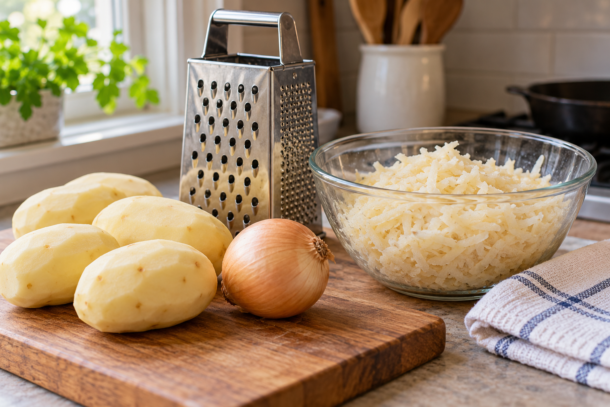
- 2 pounds russet potatoes (about 4 to 5 medium potatoes)
- 1 small yellow onion
- 2 large eggs, lightly beaten
- 3 tablespoons all-purpose flour, plus a little extra if needed
- 1 teaspoon kosher salt, adjusted to taste
- ¼ teaspoon freshly ground black pepper
- Neutral frying oil, such as canola or vegetable oil, enough for about ¼ inch in the skillet
- Applesauce and sour cream to serve
Optional: A tablespoon of chopped chives or parsley for serving, not essential to the traditional recipe. This version is designed to be accessible and reliably crisp; different families have different proportions and techniques.
Step-by-step instructions
- Prepare the potatoes. Peel the russets if you prefer a smooth, old-fashioned texture. Rinse them and grate on the large holes of a box grater. You can use a food processor with a shredding disk if cooking for a crowd.
- Grate the onion. Grate it into the potatoes. Mix briefly so the onion distributes evenly.
- Squeeze out the liquid. Transfer the mixture to a clean kitchen towel. Gather the edges and squeeze firmly over a bowl or sink. Keep squeezing until the mixture feels much drier. This step matters more than adding extra flour later.
- Mix the batter. Place the dried potato mixture in a bowl. Fold in the beaten eggs, flour, salt and pepper. Mix just until combined. The mixture should hold together when scooped, without being wet and runny.
- Heat the oil. Pour approximately ¼ inch of neutral oil into a heavy skillet. Heat over medium to medium-high heat until a tiny strand of potato sizzles immediately. Aim for roughly 350°F if using a thermometer. Keep children clear of the hot pan.
- Shape the bleenies. Drop about ¼ cup of mixture into the oil for each pancake, allowing space between them. Flatten with the back of a spoon to about ¼ inch thick, with slightly ragged edges.
- Fry until golden. Cook around three to four minutes per side, adjusting for thickness and stove temperature. Turn once with a sturdy spatula when the underside is deeply golden and holds together. Don’t crowd the skillet; work in batches.
- Drain and serve. Transfer finished bleenies to a wire rack set over a baking sheet. Sprinkle lightly with salt while hot, if desired. Serve immediately with cold applesauce, sour cream, or both.
Five tips for better bleenies
- Squeeze harder than you think. Excess water keeps the edges from crisping properly.
- Use a heavy skillet. Cast iron or a substantial stainless-steel pan holds heat when cold batter is added.
- Keep them thin. Thinner pancakes get lacy edges and cook through without burning.
- Watch the oil temperature. Oil that’s too cool makes greasy pancakes; oil that’s too hot browns the outside before the inside cooks.
- Don’t stack them wet. Rest them on a rack, not in a pile where escaping steam will soften the crust.
Applesauce or sour cream? The great bleenie debate
For some Coal Region families, applesauce is nonnegotiable. The sweet-tart contrast cuts through the rich, salty potato and makes every bite feel balanced. Others want a cool spoonful of sour cream against the crunchy crust. Still others swear by both, or eat them plain with nothing more than a shake of salt.
There’s no referee in this argument. A bleenie can be a simple supper, a festival snack or a side dish. The proper accompaniment is the one that tastes like home to you. What matters most is that the pancake reaches the table hot enough to crackle when a fork breaks the edge.
Why do bazaar bleenies seem to taste better?
Part of it is timing. At a good booth, the volunteers are making batch after batch. They are frying in hot, well-managed oil, and customers are eating the pancakes nearly straight from the skillet. A bleenie carried home and reheated hours later will rarely have quite the same edge.
Part of it is the setting: families meeting at the same picnic tables every summer, volunteers who’ve cooked together for decades, the sound of games and music nearby, and someone calling out for another order. Food acquires memories. That’s especially true of inexpensive dishes that generations learned to make together.
Not everybody grew up with a written recipe. Grandmothers taught by eye: a handful of grated potatoes, an onion, a spoonful of flour, a pan that’s “hot enough.” This version uses measurements because they’re easier to follow consistently, but it’s worth asking the people in your own family how theirs was made. You may discover that the family technique is different—and delicious.
Can you make bleenies ahead of time?
They are best fresh. If you need to prepare for a group, you can peel the potatoes shortly before cooking and organize your ingredients, but grate and squeeze the potatoes as close to frying time as possible. Finished pancakes can be held briefly on a rack in a 200°F oven while another batch cooks. Keep the oven low to avoid drying them out.
For leftovers, cool promptly and refrigerate in a covered container. Reheat on a wire rack in a 400°F oven or an air fryer until hot and crisp. A microwave will warm the center but tends to leave the outside soft. For a big fundraiser, plan safe food handling and keep cooked batches out of the temperature danger zone.
One food, a whole region’s story
It’s easy to dismiss a potato pancake as ordinary comfort food. But a bleenie captures the resourcefulness of immigrant families, the foodways that traveled across the Atlantic, and the neighborhood institutions that gave Pennsylvania’s anthracite towns their character. In some homes the name is almost a secret handshake: say “bleenies,” and somebody knows exactly which part of the state you’re talking about.
More than a century after the great coal boom, many jobs and storefronts that supported those towns have disappeared. The recipes survived because people kept making them. In a Coal Region kitchen or at a church bazaar, the simplest ingredients can still bring people back together.
Now we want to hear from you: What town makes the best bleenies? Who taught you to cook them? And most importantly, are you on Team Applesauce or Team Sour Cream? Send your memories and your family recipe through our SkookPA NewZ tip form. With permission, we’ll feature reader stories in a future Coal Region food column.
For more local heritage, read our illustrated feature on Shenandoah’s coal boom, three railroads and changing population.
Sources and editorial notes
- CoalSpeak: Coal Region dictionary, “bleenies” entry.
- Schuylkill Hub: Bleenies recipe and Coal Region food tradition.
- Keystone Newsroom: Coalcracker in the Kitchen and regional family recipes.
Recipe note: The ingredient amounts and cooking instructions are a practical SkookPA adaptation of the widely shared grated-potato pancake method, not a claim to an officially established “original” Coal Region recipe. The accompanying branded food artwork is illustrative.




0 Comments