
Published October 29, 2026. A Pennsylvania university’s examination of the Centralia mine fire is raising a difficult question for the Coal Region: How did a fire that began in 1962 grow into a disaster that emptied much of a community, even as multiple government agencies and contractors tried to contain it?
The answer offered by researchers at Susquehanna University is not that officials lacked one miracle solution. Instead, the study describes how incomplete information, conflicting incentives and problems coordinating public and private organizations complicated early attempts to control the blaze. The university highlighted the work on October 22, 2026, just days before heavy smoke from a separate coal-refuse fire in Locust Gap prompted a local disaster emergency in Northumberland County.
Important distinction: Centralia is an underground coal-seam fire in and around Columbia County. Locust Gap is a burning coal-refuse bank near Mount Carmel. Officials have not said the Locust Gap incident has become another Centralia; Pennsylvania’s Department of Environmental Protection says its fire is contained.
What the 2026 Centralia mine fire research actually found
The peer-reviewed paper, “Political Economy and Externalities: A Case Study of the Centralia Mine Fire,” was written by Susquehanna University economics professor Theresa Finley and alumnus Jacob Tomasulo. Published in the journal Homo Oeconomicus, it examines the response from 1962 through 1983, when efforts to stop the fire gave way to the increasingly urgent question of protecting and relocating residents.
The researchers examined what economists call transaction costs: the practical burdens of reaching agreement, obtaining reliable information, satisfying rules and getting different organizations to act together. In an environmental emergency, those barriers can matter even when everyone involved says they want the same outcome.
One example cited by the university concerns a contractor hired during the fire’s first year. Bridy Incorporated was supposed to excavate burning material, but according to the researchers, the state would not authorize exploratory drilling that could have helped identify the fire’s underground extent. Without that information, the contractor faced a major obstacle, and the project ended without achieving its objective.
That episode is not proof that drilling would have saved Centralia. Finley explicitly cautioned that the technology and technical difficulties of mine-fire suppression were formidable and that the researchers cannot conclusively say better coordination would have extinguished the blaze. The finding is narrower—and more useful: emergency plans can fail when decision-making, technical knowledge, authority and on-the-ground operations do not line up.
How a fire beneath Centralia became a 64-year disaster
The Pennsylvania Department of Environmental Protection traces the fire to May 1962, when a trash fire at an abandoned surface-mining pit is believed to have reached combustible refuse and then the Buck Mountain coal bed. The precise origin has long been debated, but the official explanation identifies the pit and the absence of an effective noncombustible barrier as central factors.
Once the fire entered old mine workings, it could travel unseen through coal and abandoned passages. The problem was no longer a visible blaze that local firefighters could simply soak with water. Heat, gases, uncertain underground pathways and the changing position of burning material made decisions both expensive and dangerous.
DEP’s historical chronology records approximately $3.3 million spent by state and federal governments from 1962 through 1978 on control efforts that achieved limited results. In 1983, a federal study estimated that completely extinguishing the fire could cost $663 million—an estimate made at that time, not a current project quote. Congress later appropriated $42 million for voluntary property acquisition and relocation, and the state says 545 homes and businesses were acquired and their occupants relocated between 1985 and 1991.
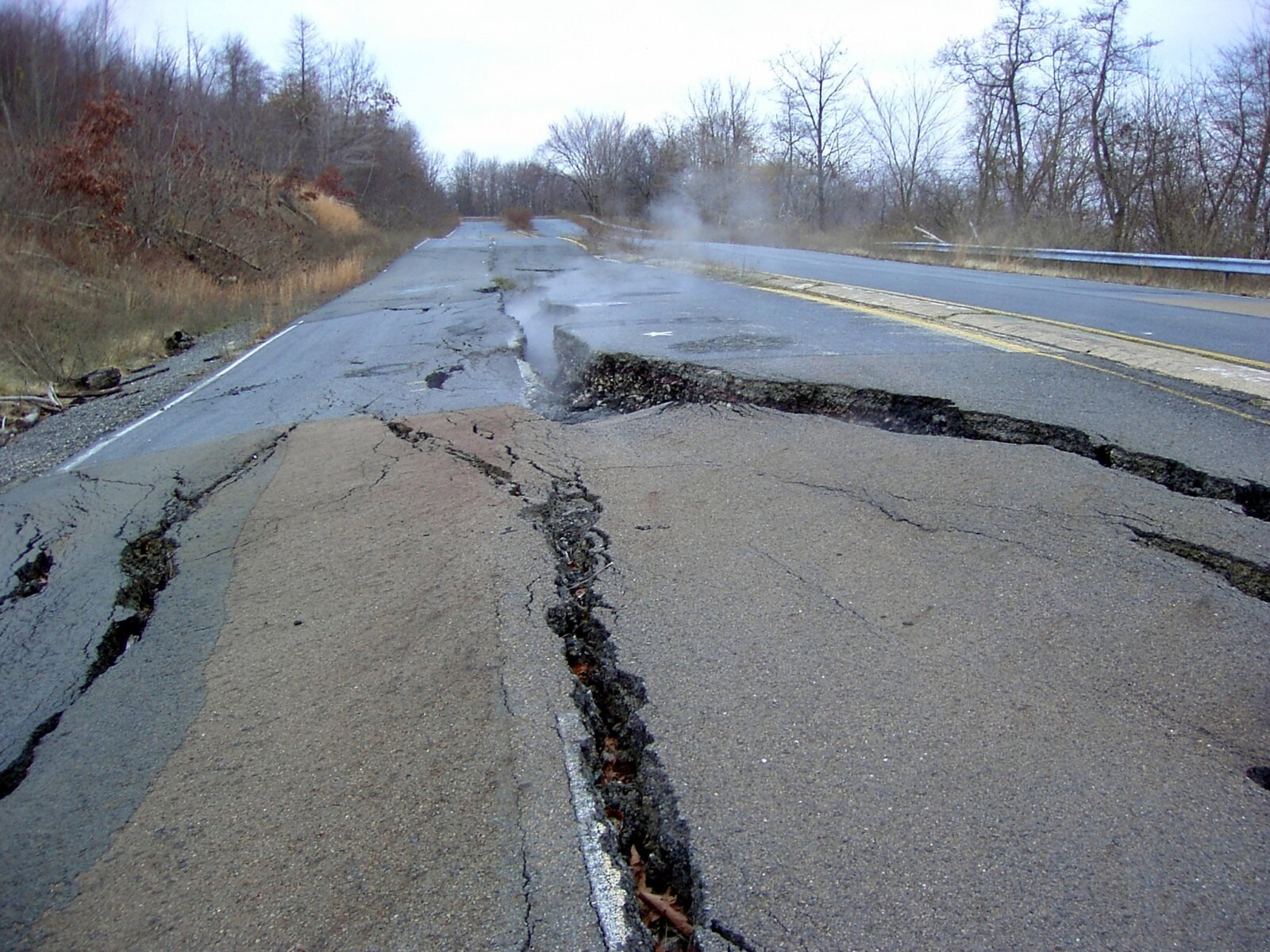
Damage extended beyond individual properties. Underground burning undermined part of Pennsylvania Route 61, and a damaged stretch was closed indefinitely in the early 1990s. The abandoned section later became known as the Graffiti Highway, but it was covered with earth in 2020; viral images of the painted roadway do not depict how it looks today.
Centralia was home to roughly 1,100 people in 1962, according to DEP. Its near-disappearance shows that the price of a prolonged mine fire is not measured only in firefighting invoices. It also includes lost homes, disrupted neighborhoods, compromised infrastructure and decades of uncertainty.
Why the Locust Gap fire is bringing fresh attention to Centralia
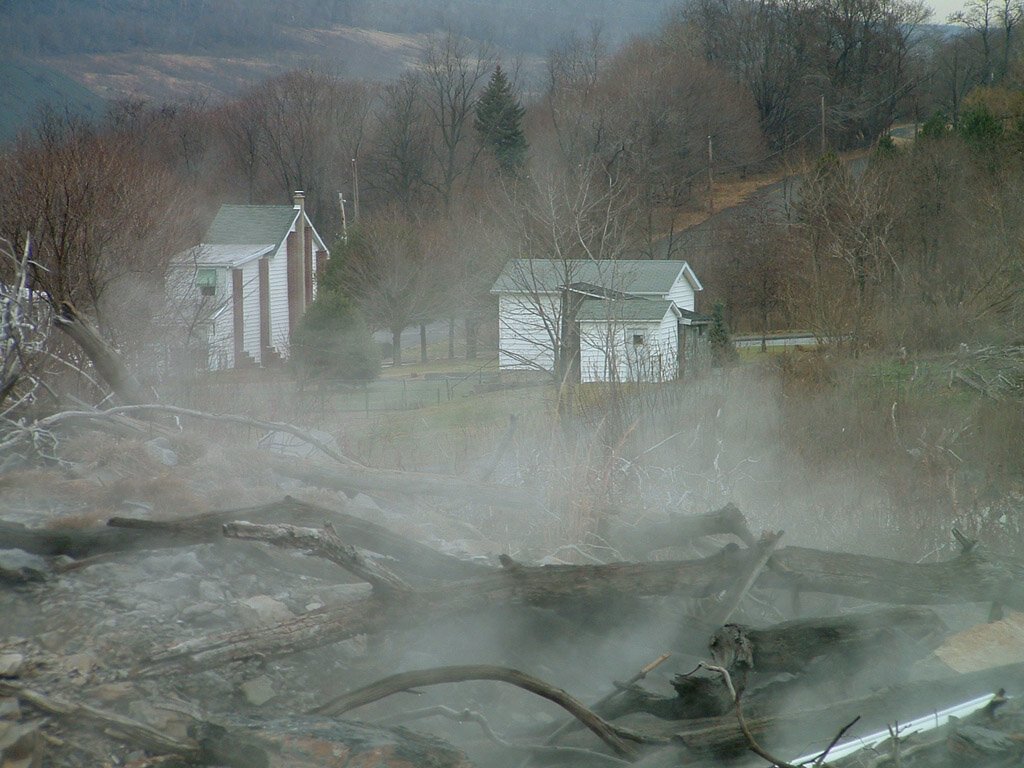
On Monday, October 26, 2026, Mount Carmel Township declared a local disaster emergency following severe smoke and fog around the ongoing Locust Gap coal-refuse bank fire. Visibility problems led to a temporary closure of part of Route 901, while residents reported odors, irritated eyes and breathing concerns. Those are serious community impacts even though the type of fire differs from Centralia’s underground coal-seam blaze.
According to DEP’s October 26–27 updates, contractors have excavated and quenched approximately 450,000 cubic yards of burning material. Another 100,000 to 150,000 cubic yards remained, leaving the work about 70% complete. Workers are digging down to a clay layer and cooling exposed material with water. DEP says perimeter monitoring shows normal underground temperatures and that the fire has not spread since extinguishing efforts began in spring 2026.
Excavation can temporarily intensify visible burning as oxygen reaches material that had been buried. DEP says it is continuing the response seven days a week, but it has not committed to a completion date.
After residents complained about worsening air conditions, DEP conducted spot checks. The agency reported no current risk in its October 26 sampling; subsequent local reporting said checks at seven locations on October 26 and 27 detected neither carbon monoxide nor hydrogen sulfide. Those limited, time-specific results do not establish that every nearby location is free of smoke, that all possible pollutants were measured or that future conditions cannot change. DEP said it was working with the U.S. Environmental Protection Agency to deploy additional monitors.
The comparison to Centralia, then, is about decision-making and public trust, not a prediction that Locust Gap will burn for decades. Current response crews are operating under a different site assessment and an organized excavation-and-quenching plan. Residents still need timely information about air monitoring, travel conditions and how much work remains.
Earlier local coverage: SkookPA’s report on the Locust Gap emergency and Route 901 visibility concerns.
What Coal Region communities can learn from the research
The study suggests several questions that deserve clear answers whenever a major environmental problem crosses property lines and agency responsibilities.
- Who is coordinating the response? Residents should know which organization is responsible for the overall plan and who can authorize changes when site conditions shift.
- What is actually known? Fire boundaries, underground temperatures, air readings and excavation progress should be distinguished from estimates or assumptions.
- Can contractors get the information they need? Access, drilling permissions, monitoring and technical decisions affect how quickly work can proceed.
- How are neighbors informed? A reassuring test result must include when and where it was collected, and officials should explain what they will do if conditions change.
- What happens if the first plan falls short? A coordinated response needs checkpoints, authority to adjust and an honest account of remaining uncertainty.
These are questions raised by the Centralia case study and the present-day situation, not accusations that any particular official has repeated a documented 1962 mistake at Locust Gap.
Is Centralia still burning, and is it safe to visit?
Yes, the Centralia underground mine fire remains active. DEP continues to monitor it and warns that the affected area is extremely dangerous. Hazardous gases and the risk of sudden ground collapse can cause severe injury or death. The agency strongly discourages visiting the fire area. A historical photograph of a steaming crack is not a travel recommendation.
The fire’s continued existence also does not mean the entire Columbia–Schuylkill border region is burning underground. The hazard relates to specific affected mine workings and surrounding ground, and current boundaries should be assessed using official information rather than social-media maps.
Questions readers are asking
Did the new research discover how to put out the Centralia fire?
No. The paper analyzes the organizational and economic reasons past efforts were difficult. It does not present a new extinguishing technique or announce a government plan to restart major fire suppression.
Did government mistakes cause Centralia to be abandoned?
The researchers identify coordination problems that likely hindered early firefighting. They do not establish that any single decision caused the ultimate evacuation or that an alternate decision would have prevented it. The underground technical challenge remained substantial.
Is the Locust Gap fire spreading underground?
DEP said in its late-October 2026 updates that the refuse-bank fire was contained, perimeter borehole temperatures were normal, and it was not spreading underground. That official assessment should not be confused with a claim that smoke-related problems have ended.
Can drivers assume Route 901 is open today?
No article describing a temporary October 26 closure can verify real-time road conditions on a later date. Check 511PA and local emergency notifications before traveling near heavy smoke.
The bigger lesson
Centralia’s story is often told through dramatic images of cracked pavement and smoke rising out of the ground. The new academic research turns attention toward something less photogenic: how agencies, contractors, officials and property interests communicate under pressure. In a Coal Region built around mining, that is a practical question, not merely a historical one.
The most responsible comparison with Locust Gap is therefore not “another Centralia.” It is this: When communities face an industrial fire, technical work and coordinated, transparent public decisions have to advance together.
Sources and photo credits
This report was independently written from Susquehanna University’s October 22, 2026 research announcement; the Finley–Tomasulo study in Homo Oeconomicus; Pennsylvania DEP’s Centralia mine fire information and safety warning and official chronology; DEP’s October 26–27 Locust Gap statements reproduced by PA Environment Digest; and WKOK’s October 28 air-monitoring update. Images and licenses are credited in their captions. This story reflects information available through October 29, 2026.





0 Comments